
25 August 2025 //
Selecting the appropriate liquid filling equipment is critical to optimizing efficiency in a packaging operation. Multiple factors should be considered, including accuracy, maintenance, changeover requirements, and return on investment. However, the selection process can become even more challenging when dealing with viscous products like adhesives, degreasers and cleaning gels, lotions, conditioners, mayonnaise, condiments, honey, or syrups, which aren’t handled as easily by some machines. Below is an analysis of the main filling technologies available when dealing with higher viscosity liquids.
Overflow Fillers
Overflow filling machines are designed to fill containers to a specified level. The main components include a fill nozzle and an overflow tube. These simple machines fill containers until the overflow tube starts capturing excess product and directs it to a secondary tank, and then the machine automatically stops filling.
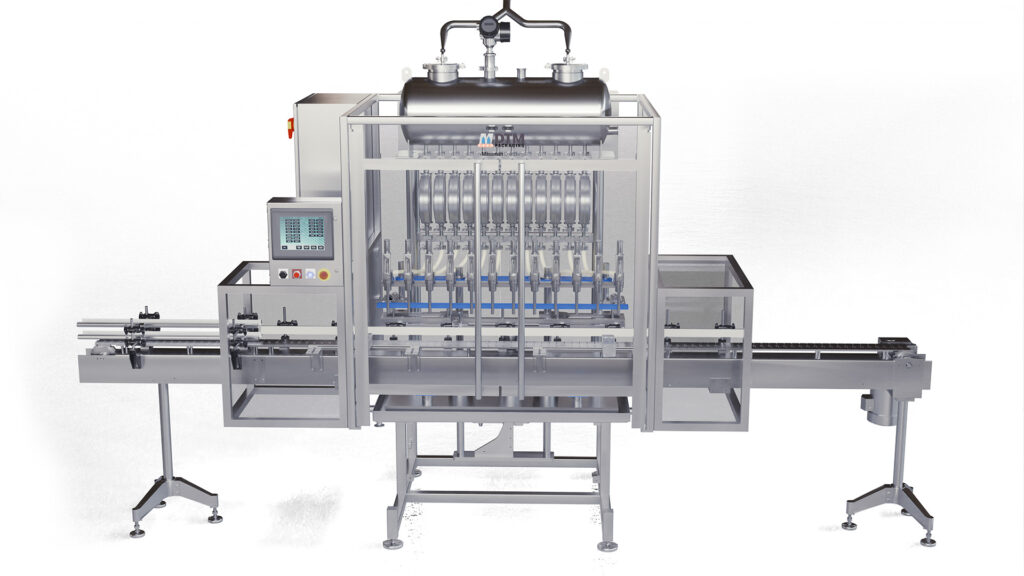
Because overflow fillers are based on the level of product, they lack in accuracy and consistency. The inaccuracy is amplified if a misshaped bottle enters the system, which results in it receiving a different amount of product than the other containers. Another key drawback of these machines is their inability to handle viscous products. Liquids must be free flowing in order for them to function properly, since the machines utilize gravity flow. Additionally, thicker fluids have a more difficult time entering and flowing through the overflow tube.
The biggest advantage of this system is the price, as it is generally the most cost-effective filling option available. Therefore, it’s best for budget-minded operations that don’t require accuracy in the end product, nor will they receive a return on investment from the product savings achieved with a more accurate filler.
Other factors to consider are maintenance, space constraints, and product changeover requirements. Because overflow fillers have no moving parts, maintenance is minimal, and changing from one product to another is fairly easy. To change over, operations simply run an ample amount of cleaning solution through the lines into separate containers before switching to a new product.
In most cases, space isn’t a concern with overflow fillers. However, do consider that some extra room is needed for the overflow tank in addition to the product tank.
Piston Fillers
Piston filling machines utilize a well-established and proven technology that’s gained a reputation for a high level of accuracy, even with higher viscosity products, making them a preferred choice in many packaging operations. However, it’s worth noting that these machines fill containers based on volume and not mass. The density of a liquid can fluctuate throughout the day as conditions, such as temperature, change. This may create challenges when verifying the accuracy of piston machines, as different batches of filled containers may not weigh the same, despite having equal volumes of liquid.
Another concern with consistency is the potential need for downstream verification. If, for some reason, a cylinder doesn’t properly fill with product, then it will dispense an inadequate amount of liquid into a container, undetected by the machine. As a result, a manual or automated reject system may need to be put in place down the line to identify and remove any errors after filling.
While the biggest advantage of piston fillers is their accuracy, drawbacks include price, space, maintenance, and changeover processes. These machines are a higher cost option that need more space than an overflow machine. Additionally, they require a fair amount of regular maintenance, such as seal replacements.
Perhaps the biggest concern with piston fillers is product changeovers, which often takes a full day or more. These machines must be disassembled and the internal parts manually scrubbed to clean the system in between products. Simply changing fill volumes with one product isn’t easy, either, since time-consuming mechanical adjustments may be needed. In fact, if making big changes to fill volumes, the piston itself may have to be switched. Therefore, even if an operation makes few product changeovers or volume adjustments at the current time, it’s important to think to the future before installing a piston filler to reduce potential headaches down the road as the business expands into more products and container sizes.
One of the biggest drawbacks of piston fillers is the time and labor required for product changeovers—often a full day or more. The system must be completely disassembled, and every internal component manually scrubbed before switching products. Even adjusting fill volumes for the same product can be a slow process, involving mechanical adjustments that may require swapping out the piston itself for large changes. While these challenges might seem manageable if you rarely change products or volumes today, they can become costly bottlenecks as your business grows into new SKUs and container sizes. Planning ahead now can help avoid major headaches later.
Gear Pumps
Gear pumps are another filling option that share a lot in common with piston fillers. For instance, gear pumps are highly accurate volume-based fillers. But, they are also expensive, need regular maintenance, and take up a large amount of space. The changeover procedure is time consuming as well. Nonetheless, some operations prefer this type of system due to its reliability and accuracy. Many times today the decision to install a gear pump is made because the facility has other gear pumps in operation, or simply because that’s the way they’ve always done it.
Flow Meters
 The final type of filling system for viscous liquids is flow meters. Two general types of flow meters exist today: magnetic and mass metered.
Magnetic Metered: These flow meters are capable of handling viscous liquids, as long as they are electrically conductive. Despite being accurate and reliable, these machines fill containers based on volume, leading to some of the same concerns as piston and gear pump fillers. Also, they limit expansion into use with non-conductive liquids.
Mass Metered: Although this style costs somewhat more than magnetic metered options, the difference can oftentimes be paid off in a few short months. The mass metered design provides greater flexibility, since liquids don’t have to be electrically conductive. Additionally, it is highly compatible with a wide range of viscosities and other product characteristics like the stickiness of honey or the foaming of cream. With mass metered machines containers are filled based on weight and not volume, making them perhaps the most accurate and verifiable option among filling machines. In fact, average fill volume accuracy is generally around +/- 0.25%.
 In addition to the accuracy of flow meters, many operations enjoy the ability to add an integrated reject system, which automatically kicks out any container that is over- or under-filled. This eliminates the need to add checks downstream to ensure all containers are filled properly before they leave the facility.
The other key advantages of flow meters are related to maintenance, hygiene, and product changeovers. These machines have no moving parts, so there is practically no regular service needed to maintain a high level of performance. Plus, they are highly sanitary without areas for potential contamination, which makes them excellent choices for sensitive industries like food, pharmaceutical, and others.
Also, the clean-in-place (CIP) systems on flow meters allow operators to automate changeover procedures. The machine thoroughly cleans itself ahead of the next batch, requiring minimal time and effort. Operators can simply use a touchscreen to initiate the changeover procedure and then select the appropriate recipe to begin filling the next product.
Flow meters are better capable of filling different container sizes as well. The metering technology, combined with reliable servo drives, allows these machines to easily change volumes with the simple press of a button, rather than having to manually adjust piston fillers.
Flow meter fillers also excel at handling a wide range of container sizes. Their advanced metering technology, paired with precise servo drives, allows operators to change fill volumes instantly with the push of a button—eliminating the time-consuming manual adjustments required on piston fillers.
While the cost of a flow meter filling system is comparable to a piston filling machine, the return on investment is often greater. This is because less maintenance and downtime are needed to clean the system and perform product changeovers. The high level of accuracy may also result in savings through less product waste.
The final consideration, especially when comparing flow meters against piston or gear pump fillers, is space. The in-line configuration of flow meters requires much less room, which can be a major advantage in smaller facilities.
Making the Final Decision
In summary, each filling technology offers distinct advantages and trade-offs. Overflow fillers excel in simplicity and low cost but lack precision and struggle with certain viscous products. Piston fillers handle thicker liquids well but can be slower to clean and less adaptable to product changes. Gear pump systems deliver good accuracy yet can be more expensive and require more maintenance. Flow meter fillers, especially those using mass measurement, offer the best balance of accuracy, flexibility, and efficiency, making them a strong fit for most modern production environments.
Ultimately, selecting the right liquid filling technology depends on multiple factors, from product characteristics to long-term operational goals. Partnering with an experienced, reputable supplier is essential—not only to match the right solution to your needs but also to provide ongoing support and service long after the sale.