
23 September 2025 //
In-line flow meter fillers bring unmatched accuracy and agility to food-grade production.
Efficiency is everything for bottling and packaging equipment. With modern production trending toward shorter runs and faster changeovers, manufacturers can’t afford to be slowed down by equipment that isn’t designed for flexibility.
Rotary fillers remain the preferred choice for high-speed, single-product filling lines dedicated to continuous, high-volume production. However, for small- to mid-scale operations, a different filling system has become the standard in applications requiring superior precision and flexibility — the in-line flow meter filler.
In-line fillers shine the brightest in scenarios where change is constant. Companies can move between packaging personal care products, pharmaceuticals and chemicals with ease. The simple, effective design of in-line fillers makes them particularly adept at packaging high-viscosity food products. Whether you’re bottling honey, ketchup, mustard or syrups, in-line systems offer a level of control and product versatility that has become increasingly valuable.
In-Line Adaptability
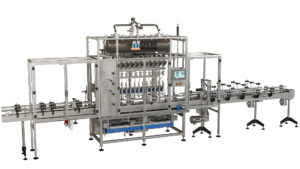 In-line fillers distinguish themselves from their rotary counterparts in numerous ways, starting with taking up less space. The smaller footprint makes them an attractive option for facilities with limited square footage available.
They also come with a lower upfront cost and require significantly fewer change parts, which dramatically simplifies product or container changeovers. For producers that manage dozens of product types and packaging formats, in-line technology allows a single machine to accommodate up to 30 or 40 different bottle styles with minimal changeover effort — it’s often just a quick swap of a feed screw and a recipe adjustment on the touchscreen interface.
The time difference for changeovers between the two systems is dramatic. Switching over to a different product within a rotary system can take hours or even a full day since there are more change parts and far more cleaning involved. On the other hand, in-line fillers can be ready for a new product in as little as 15 minutes.
The ability to quickly adapt between products translates into incredible efficiency gains. Multiple short production runs of different foods or other products can be completed in a single shift without any concern of sacrificing fill quality or product integrity.
Another feature contributing to the speed of some in-line filler systems is a walking beam nozzle rack that keeps bottles in continuous motion during the filling process. Because the containers don’t need to pause in place for each fill, the walking beam design results in faster operation and more overall output.
Reducing Product Giveaway
In-line filler technology typically uses high-performance flow meters. Mass flow meters are preferred for their ability to measure virtually any product type with outstanding accuracy, due to the system weighing the filled bottles instead of measuring based on volume. Although they come with a higher cost than basic systems, the investment is justified very quickly by reducing product giveaway.
Older or less precise fillers may require operators to intentionally overcompensate to ensure they aren’t underfilling any containers. For example, a target fill of 100 grams might require the system to be set at 120 grams. Over the long run, manufacturers with these systems are essentially forcing themselves to give away massive quantities of product.
With a modern in-line system, the same fill could be confidently set at 102 grams, with actual fills never fluctuating by any more than a gram. That’s a substantial reduction in wasted products. And in high-value food applications, those savings can add up fast. In fact, real-world users have reported gaining back a complete return on their equipment investment within six months, thanks for improved filling accuracy alone.
An in-line system’s real-time feedback capability ensures tighter control for the manufacturer. As product is dispensed into the container, flow meters continuously report fill volumes back to the system. If a fill falls outside of the present tolerances, the system instantly flags the issue; it can even reject the container if needed. If the issue recurs, operators can quickly determine the cause of the deviation, whether it’s related to a problem with a single nozzle or due to a change in product viscosity.
Viscosity Variance
In-line fillers are well-suited to handling a wide range of product viscosities — from food items like honey or nut butters to personal products like water-thin oils or thick hand creams. Instead of changing out large sections of the system or reconfiguring hardware, operators can simply adjust the tank pressure to keep running.
Because the tank sits directly above the fill system and maintains a constant, controllable pressure, the flow through each meter remains stable and predictable. This consistency gives the whole system the ability to shut off at precisely the right moment. In other systems, overshoot or “coasting” can occur because the pump lags slightly behind the sensor input.
Some in-line systems are engineered to compensate for variations in viscosity or specific gravity. This is done by allowing quick tweaks to the pressure settings, which may need adjusting if the operator observes slight differences when running a new batch of a viscous product. These simple pressure adjustments typically eliminate the need to investigate or recalibrate other machine parameters.
Standard practice for products like honey is to provide adequate warmth for it to flow smoothly. For any heated product, systems can be equipped with heated tanks, hoses and flow paths; alternatively, a recirculated jacket system could keep hot water flowing through the outside of the tank.
With the wrong equipment and a poor nozzle design, stringing and dripping can be nuisances with viscous product filling. The best in-line systems, however, utilize positive shutoff nozzles that close right at the tip, eliminating any residue that would otherwise cling to the bottom of the filler.
Additionally, air entrapment — a common problem in thick or foamy products — is minimized by the way these systems fill and draw product. Product is pumped into the bottom third of the tank, allowing any air bubbles to rise and be vented naturally. Product is then drawn by the bottom of the tank where it’s most stable. This simple, intentional design choice greatly improves fill consistency.
Cleanability
 In-line systems excel in sanitation-critical environments. Design enhancements such as fully welded frames, IP69 waterproof components, and crevice-free surfaces allow these systems to meet the most demanding cleanability standards.
Food-grade machines have their own set of more stringent requirements, including stipulations where no threaded or bolted connections are allowed on certain parts of the machine. In addition to helping meet regulatory compliance, these designs also simplify every clean-in-place (CIP) cycle to greatly save on water, labor and especially time.
CIP processes on food-grade in-line systems are often just as streamlined as mechanical changeovers. A typical CIP protocol can be completed in about 15 to 45 minutes depending on the machine and application — far faster than the multiple-hour cleanings required for a rotary system.
Competitive Edge
As production strategies shift toward smaller batch sizes and more frequent changeovers, speed, precision, and flexibility have become critical on the packaging line. In-line flow meter fillers are engineered for this fast-paced reality, enabling rapid changeovers between products, container sizes, and viscosities without sacrificing accuracy or uptime.
From food-grade applications to specialty products, these systems deliver an exceptional balance of adaptability and control, driving measurable gains in productivity and profitability. In-line fillers aren’t just a better way to fill containers; they’re a smarter way to compete.